

An uncontroversial preface to Vir Das' new work
Weekend at Bangalore Literature Festival 2025

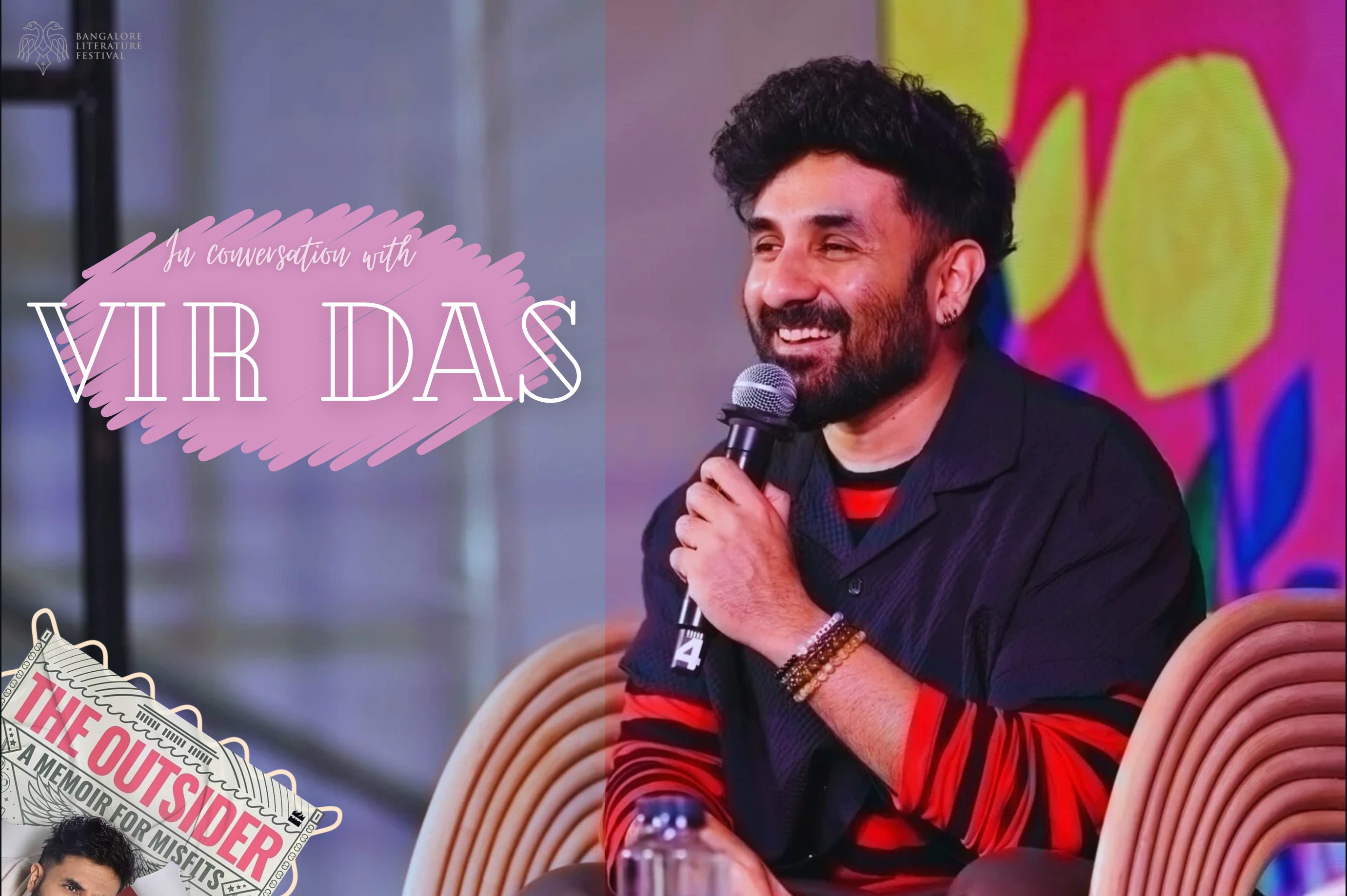
News flash: Popular actor turned comedian turned actor flips the pages back in his debut book.
Originally a stand-up comic, Vir Das became a household name in India after his breakthrough role in the 2011 dark comedy film Delhi Belly. After a short and successful stint in Bollywood, Vir turned to stand-up comedy in 2017 and became the first Indian comedian to score a comedy special on Netflix. One show led to another, and then the first Emmy nomination for Vir Das: Outside In. Now an international celebrity, his fame reached a new high with the 2023 International Emmy Award for Best Comedy Series for the Netflix comedy special Vir Das: Landing.
And now, one of India’s best comic exports came back to his home soil with his debut book, The Outsider: A Memoir for Misfits.
Day one of the 14th edition of the Bangalore Literature Festival opened to the air fluctuating between warm notes of classical music and unisons of untimely applause. It was then the turn of the jester. “Twenty-five years ago, nobody knew what stand-up comedy was, but we all knew what journalism was,” said Vir as Anna MM Vetticad, an award-winning journalist and film critic, greeted him on the ornate stage. She promptly acknowledged the rise of stand-up comedy across the country while countering with the fact that both comedians and journalists are in the same boat when it comes to struggle. It paved the way for her next question about Vir’s colorful history of contentious work.
“I unapologetically take the freedom to talk about anything on the stage, so it would be disingenuous for me not to give that freedom to an audience member,” Vir responded. “So if you are upset or offended, that’s very much your right… Maybe phone calls (to me) after you are offended is a different thing… Right? What I have figured out the long and hard way is, you know, people with power—no problem; people with no power—no problem; people with no power who know power… are the people to be afraid of.” As the crowd, which was now spilling out of the watchtower arena, burst into a fit of laughter, he made the analogy using the VP of sales as the people to be afraid of on the corporate ladder. Vir capped this segment on a sober note by saying, “...eventually the constitution does protect you. The punishment is the process. It’s not the outcome; it is the paperwork and visits and media headlines, and all of that stuff. The process is quite painful. But eventually, I believe, we have a strong, rigid constitution that protects the freedom of speech.”
Anna’s next question left Vir baffled, as it was concerned with the content of his comedy specials. “I am in my forties. If you’re apolitical in your forties, what kind of life will you have?” said Vir after explaining the balance of things in a perfect stand-up—things you want to say and the things the audience wants to hear. It could either be indulgent to the listeners or go off on a tangent. He stressed the importance of the content that surrounds us and the trivialities that he let go of. He also acknowledged the lack of stakes that comes with not having children. According to him, one can never predict what kind of content yields the best results. Anything can go viral, and the ones you have the premonition of making a buzz often fall flat. He is only familiar with one type of content, which he has created so far. “My best case is: See it, and jab lag jati hai (when you face the heat), then you be cool.”
Anna then switched gears and asked about his intentions behind writing a memoir and how one of her friends considered it to be about Two Indias, a topic that got Vir in trouble. He replied jokingly with the one-word response—Cash—and then clarified that it was only 90% about cash. He mentioned that it was not uncommon for a comic of his age to write a book about their life, as his contemporaries Kevin Hart, Amy Schumer, and many others have. “You won the Emmy, then write the book,” he stated as the trajectory of the American career graph. He felt he had not done enough work in the stand-up field and could only write a book about confusion and failure. Compared to other people he had encountered, he had been in a variety of worlds, gatecrashing from one place to another and coming out with the feeling of unbelonging. And that’s what his book is about: the outsider.
Vir recalled his first time meeting a Bollywood star after moving to Bombay on a whim. “I believe if you’re young and you’re perceptive, there are moments where the universe will let you know that you need to be undeniable. You feel it, and that’s what I felt too,” he added. His first Bollywood encounter was with Jackie Shroff, with whom he spoke for five minutes without ever registering a word, in part because he was star-struck and in part because it was Jackie Shroff. Then, out of the blue, Aishwarya Rai came and fist-bumped him. And that was the end of the show for poor young Vir Das. He joked about the concept of upper biology in this world and how commoners like him (and the audience) didn’t just belong. This was a glance at the kind of stories he wanted to convey through his memoir.
Anna cut through the belly-laughing crowd by reading a passage from the book where Vir talked about boarding schools in the format of a quippy essay. He divided the students in boarding schools into two categories, namely, happy conformists and miserable misfits. Anna described the current Vir Das as a happy misfit, which he wholeheartedly admitted and credited to his journeys around the world, seeing it as an outsider, for his current outlook. Anna then asked about his outlook towards other comedians from a seat in the audience. He responded plainly, describing comedians as ones who know the craft just as well. “Comedians love it when the other comedian bombs,” he added. He talked about his visits to Mumbai’s local comedy clubs with his peers and the democracy of the comedy scene, which can elevate any comic above you in five minutes on any given night.
[Spoilers for the book in the next paragraph]
“I was engaged with my fiancé, and she went abroad before we planned our wedding, and I got cheated on four months before she was to come back,” Vir said before he read a passage from The Outsider: A Memoir for Misfits. “My friends introduced me to this girl in Mumbai, who was also freshly heartbroken. And we were like, ‘let’s just bang, please.’ So she’d come over, and we’d smoke up and hook up and eat Bavarian chocolate ice cream from Baskin-Robbins ‘cuz we were very high and talk about our exes. And with every passing week, we’d talk less and less and less about our exes. And just as soon as we stopped talking about our exes, my fiancé came back, and I decided that I’d take her back. She lived in Delhi, and so I needed to say goodbye to the girl with whom I used to get high. And the passage is about that.”
(A few minutes later…)
After the passage reading, which ended on a happy note, the wild crowd roared with applause that might have affected the timely procession of nearby events in the festival. Then, it was time for the much-awaited Q&A.
(Note: It was here that Vir realized that the Bangalore Literature Festival was free for all, which may or may not have affected his subsequent answers.)
“I am not dying. Much to the disappointment of a few organizations and a few official bodies, I am very much alive, still writing jokes. More jokes are to come,” said Vir when asked by a concerned person in the audience, wondering if the reason behind writing a book was the arrival of some potential bad news. “I don’t have any other stories to tell, and I don’t want to make the movies or, you know, into comedy movies. So, I just felt like…you know, sometimes you feel like everybody’s coming and seeing you for all of these years, but we haven’t really gotten to know each other. And it’s a nice way to share yourself with your own,” he added as the reason behind writing a memoir.
“Ma’am, I want to push back on that. I think this younger generation has far more sense of humor than our generation.
I think sometimes, because we come from a space of not having open conversations, we perceive an open conversation as a lack of sense of humor. I think this generation talks more about body issues, mental health problems, anxiety, etc.—things that we just kind of regularly put under the table, etc.
They’re open about it. And they have a darker, drier sense of humor,” responded Vir when asked about the problems with the current generation. “You know, so when I see a Gen Z kid like, ‘Man, my anxiety is uncontrollably telling me I need this emotional read.’ That is essentially a sense of humor combined with openness that my generation doesn’t really have. So, I’m a big fan of how open they are. Did they get stuck in it or not? I think. You know, a lot of that is angst, a lot of that is edge, like all those times in younger comics, you know, twenty-one-year-old male comics with, you know, hesitant humor, and then, when a girl kisses you, all of that will fly out one day and all. So I think life experience will, kind of, you know, weld them into that part. But I do think that they are far funnier than we are.”
The next question asked Vir about the time a producer said something brutal about his looks, to which he responded, “One producer?” He recalled his time in Bollywood after his first movie when two producers called him up and said, “This boy, not very good-looking. Also, not very tall.” Vir looked back at his time in Bollywood in a sad but thankful light because of the direction his career took.
When asked about all the perks and the money that come with his celebrity status, Vir responded by stating that money could be dangerous in his profession. “As a comedian, you need to be very careful about not surrounding yourself with too many people,” he added. “Three years. If you get success during that time, please lose yourself.
Please be an asshole, all right? Please wear sunglasses at airports, and have two cell phones, and have somebody waiting there with Baba Ka Juice (protein shake?), but eventually find a way back to being authentic.”
Towards the end of the session, Vir was bombarded with questions from all walks of life. For one such question, he clarified his take: “If you don’t speak up because you don’t have kids, I don’t judge you for that.” For another question, the backlash after his controversial Netflix special, he talked about the stand he took to avoid using public attention to climb up the industry ladder. Fans in the audience didn’t miss the chance to ask him about his comeback to Bollywood after ten years with his new film in 2026. As far as book suggestions go, Vir regarded Khushwant Singh’s History of India as the greatest history book ever written about India.
In his final moments, Vir bookended the session by sharing what goes through his thoughts behind the stage and admitting that, like the rest of us, he only puts on a brave front and is scared 90% of the time.
See more blogs in the collection of Bengalore Literature Festival Dispatches 2025.